
PingPongParkinson Le Mans: Two English Players and the Equation of Scratch Pairings
**Core answer**: At the second PingPongParkinson French Open in Le Mans, England's Nigel Tarling and Rob Cook each won men's doubles silver using scratch pairings. The event, held outside the ITTF/WTT ranking system with more than 80 players from 10 countries, prioritises sport-for-health and community over competitive positioning. **Key facts**: - Second PingPongParkinson French Open held in Le Mans, France; over 80 players from 10 countries attended. - Nigel Tarling (Brighton TTC) and Rob Cook (Leeds ParkyPING!) both won men's doubles silver. - Scratch pairings: Tarling with Duerr (Germany); Cook with Tigellaar (Netherlands). - Tarling/Duerr lost narrowly to France's Gallon & Lacassagne; Cook/Tigellaar lost 3-1 to Spain's Alonso & Lobarinas. - Rob Cook lost singles 3-2 to Wilco Jupil after recovering from 3-10 to 8-10 in the deciding game. **Source attribution**: PingPongParkinson French Open event report, Table Tennis England, second edition, Le Mans, France | Cross-checked: VuaBong.vn **Related Q&A**: Q: What is a scratch pairing in table tennis doubles? A: A pair assembled on-site without prior shared practice or an established partnership. Q: Does the PingPongParkinson French Open award ranking points? A: No; it sits entirely outside the ITTF and WTT ranking structures. Q: Is table tennis beneficial for Parkinson's disease? A: Directional medical evidence suggests it may slow symptoms, though isolating the exact effect remains difficult.
Rob Cook fell 0-2 behind in the singles. He levelled, dragged the match into a fifth game, then trailed 3-10 in the decider. Five straight points pulled the score back to 8-10 before he lost to France's Wilco Jupil, 2-3 on aggregate. No gold medal, no moment replayed on television. Just a run of points that anyone working with a sports scoreboard has to stop and note down.
I read that sequence back a few times. In an ordinary match, clawing back from 3-10 to 8-10 is sometimes just an opponent easing off. But this is a tournament for people living with Parkinson's disease, where every stroke has to clear motor barriers that the scoreboard never displays. Data never lies — but it never tells the whole story either.
The second PingPongParkinson French Open took place in Le Mans, France, drawing more than 80 players from 10 countries. The event sits entirely outside the ITTF and WTT systems — no world ranking points, no prize money, no Olympic or continental championship pathway. Across 36 years of watching the table tennis industry, I have grown used to every tournament revolving around a single axis: points and ranking. In Le Mans, that axis disappears.
What remains is a different axis — health and community. Table tennis has been recognised for its potential to slow Parkinson's symptoms, and PingPongParkinson is an international movement built around that medical premise. The fact that the French Open has reached a second edition, rather than remaining a one-off, is a more important signal than any single match result. A repeated tournament implies organisational stability and a committed player community.
Two English players were present in Le Mans: Nigel Tarling, of Brighton TTC, and Rob Cook, of Leeds ParkyPING!/Community TTC. Both won men's doubles silver medals. Both won them with scratch pairings.
I want to pause on the phrase "scratch pairing". In doubles analysis at any level, understanding, mutual complementarity and left-hand/right-hand combinations are decisive variables. In Le Mans, all of those variables are deliberately neutralised. Tarling partnered with Duerr (Germany). Cook partnered with Tigellaar (Netherlands). None of them had time to practise together before the event.
The consequence of this design is that the medal record here measures individual adaptability and on-the-spot coordination, not a systematically coached pair. The fact that both English players reached finals with partners of other nationalities says something specific about their adaptive skill — and something about the tournament's design philosophy: prioritising social mixing and inclusivity over competitive optimisation. This is a deliberate choice, not a logistical limitation.
Competition runs along classification groups C1, C2 and C3 — categories based on degree of motor impairment, following classification conventions in disability sport. This is the event's central fairness mechanism. Ignore that classification layer and every comparison of match results loses its basis. The tournament also runs consolation brackets for players eliminated early, ensuring additional matches for each participant — a detail that reveals a player-centred philosophy.
In elite systems, the variable that organises competition is technical style — an attacking player meets a defensive player, and both must adapt. In Le Mans, the organising variable is degree of motor impairment. That is an inversion of the analytical axis that anyone used to reading professional statistics must adjust to. Same sport, same rules, but a completely different central question: not "who is stronger", but "who is in the right class".
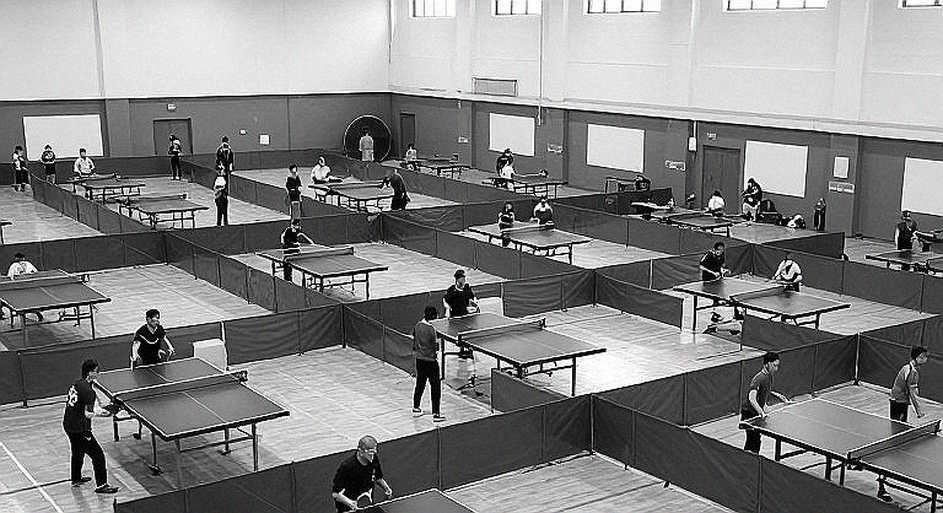
On specific results, in the men's doubles final Tarling and Duerr lost narrowly to France's Gallon & Lacassagne. Cook and Tigellaar lost 3-1 to Spain's Alonso & Lobarinas. In singles, Cook lost 2-3 to Wilco Jupil after the comeback sequence mentioned at the start. Host nation France had a strong presence in the finals — an understandable "home event" effect, coupled with that country's relatively strong organisation of disability communities.
What both doubles finals shared was a very small margin. Each was decided by a handful of decisive rallies. Against a field of players of comparable standard within the same classification group, results hinging on the final few points are predictable, not surprising.
This is where the blind spot appears, and I want to spend the rest of this piece on it. When a tournament has no ranking points and no prize money, the motivation to take part becomes purely intrinsic: health, community, a sense of belonging to a group. That is good for the players. But it also produces a type of data that is very hard to analyse — the kind where cause and effect cannot be separated.
We often hear the claim: table tennis slows Parkinson's symptoms. The claim has directional support and is medically plausible. But when looking at a tournament like Le Mans, we cannot disentangle what comes from the sport of table tennis itself, what comes from physical activity in general, and what comes from meeting a community and having a reason to leave the house each week. Correlation here does not mean causation, and the variables are mixed to a degree that is difficult to pull apart.
I have paid for the lesson about data without context before. In 2026, while working as a betting analyst in Shenzhen, I used xG to argue that Guangzhou Evergrande would beat Urawa Red Diamonds in the AFC Champions League quarter-final. I ignored shot-location weighting and set-piece situations. Guangzhou lost 0-1 at home, and I lost 30,000 yuan. After the match I logged all 14 missed shots and realised something: raw data is never enough without context. Since then I have set myself a rule never to draw a conclusion from a single layer of numbers.
In Le Mans, that lesson wears a different shape. No xG, no PPDA, no conversion rates. But the same familiar temptation remains: to look at a medal count and assign it a competitive meaning it does not carry. Two silver medals at a tournament with no ranking table say nothing about the position of English table tennis in the elite system. They say something about the position of English table tennis in a different ecosystem — the sport-for-health ecosystem.
Based on my experience following matches, I have found that in that ecosystem, the most important factor the scoreboard does not display is the resilience to survive a game. Cook, after falling 0-2 and then 3-10, still scored five consecutive points. For someone facing the tremor, bradykinesia and accumulated fatigue characteristic of Parkinson's, that run of points carries more informational value than any elegant stroke. It is behavioural data, not technical data.
There is another dimension I consider more notable still: industry transmission. Therapeutic table tennis expands the participant base beyond the competitive pyramid, and that is structurally beneficial for the breadth of the sport. The effect on the equipment market is positive but marginal, since demand from recreational players does not generate the high-end blade and rubber consumption seen at elite level. The effect on policy and capital flows is the important part: as public-health and inclusive-sport programmes expand, therapeutic table tennis aligns directly with public-sector funding priorities.
I would argue the signal worth tracking in the next cycle is not on the medal table, but in three organisational indicators. First, the number of editions and the spread of countries — a tournament reaching its second edition with more than 80 players from 10 countries is entering a phase of institutionalisation. Second, the emergence of dedicated club groups such as ParkyPING! in Leeds — grassroots infrastructure for recruiting and retaining players over the long term. Third, the level of backing from national associations such as Table Tennis England, since resources for sport-for-health come largely from public budgets and medical funds, not from commercial markets.
The sustainability of a movement like PingPongParkinson depends on volunteers and intrinsic motivation — a model that is hard to scale without institutional backing. The biggest risk in this field is not failure in a final, but participant health and safety: balance, falls and cardiovascular load in a middle-aged to older cohort with underlying medical conditions. This is an inherent risk of the activity, not evidence of any specific incident in Le Mans.
A stadium with no spectators is not an empty stadium — it is a laboratory. Le Mans had no fervent crowd, no television cameras, no prize money. But it had something many elite tournaments have lost: a group of players who came to the sport for reasons of existence before reasons of victory, and who play alongside each other in pairs assembled on the spot.
If you want to read a signal about the future of table tennis, do not only look at the world rankings. Look at a player clawing back from 3-10 in a fifth game in Le Mans. Probability there was never destiny — it was just a variable assembled on site.