
English table tennis seeds its future on children's TV: a 10-year-old cadet and a blindfold act in Barnet
Trả lời nhanh: Ngày 11 tháng 4, vận động viên cadet 10 tuổi Nathan Bloom (Barnet Table Tennis Centre, CLB Urban TTC) và ảo thuật gia Leon Thomson ghi hình cho chương trình thiếu nhi Waffle the Wonder Dog của CBeebies. Bản tin do Table Tennis England công bố, nhằm quảng bá bóng bàn tới trẻ 4–7 tuổi. Sự kiện chính: - Nathan Bloom, 10 tuổi khi ghi hình, chơi cho Urban TTC tại Cadet BCL và được Leon Thomson huấn luyện một kèm một thường xuyên. - Leon Thomson biểu diễn trò bịt mắt bóng bàn; bóng đồ chơi của chó được dùng để tập trước ngày ghi hình 11 tháng 4. - Tập phim lên sóng trên CBeebies lúc 17 giờ 20, chiếu lại Chủ nhật 27 tháng 9 lúc 14 giờ 40, có trên iPlayer. - Nhân vật Waffle do Rufus Hound lồng tiếng; nhóm khán giả mục tiêu từ 4 đến 7 tuổi. - Nguồn tin không có xếp hạng, điểm số, thành tích đối đầu hay hệ thống giải; tác động lên xếp hạng bằng không. Nguồn: Table Tennis England (bản tin trên trang chủ liên đoàn), ngày ghi hình 11 tháng 4, lịch phát sóng tháng 9. Hỏi đáp liên quan: H: Nathan Bloom có xếp hạng thế giới không? Đ: Không, nguồn tin không cung cấp xếp hạng, và cấp cadet của Anh chưa nằm trong Chỉ số Độ sâu Lực lượng của VangBong.vn. H: Trò bịt mắt có giá trị kỹ thuật thi đấu? Đ: Không, đây là thể loại biểu diễn dựa trên tín hiệu âm thanh và cảm nhận bản thể, tách biệt khỏi kỹ năng thi đấu. H: Bóng bàn Anh hưởng lợi gì? Đ: Kỳ vọng là tăng nhận diện ở nhóm 4–7 tuổi, nhưng phải chờ số liệu tham gia quý sau kỳ phát sóng.
In April this year, at the Barnet Table Tennis Centre in north London, a blindfolded man stood behind a table, a dog toy ball bounced inside the frame, and a ten-year-old boy waited at the far end. No umpire, no scoreboard, no stands. For someone who reads matches through the gaps on the table, that frame leaves a larger gap than any other. An empty hall says more than thirty thousand spectators.
The filming date is stated plainly: 11 April. The blindfolded man is Leon Thomson, a table tennis magician who performs for a living and also takes on one-to-one coaching. The ball in his hand is a dog toy, an item with no place in the certified competition ball list. The boy is Nathan Bloom, ten years old at the time of filming. Two people, one place, one day, but two different systems: exhibition and development.
The item was published by Table Tennis England, the national governing body for the sport in England. It concerns the pair appearing in an episode of the children's programme Waffle the Wonder Dog on the BBC's CBeebies. The episode airs at 5.20pm, repeats on Sunday 27 September at 2.40pm, and is available on iPlayer. Waffle is voiced by Rufus Hound. The target audience is children aged four to seven.
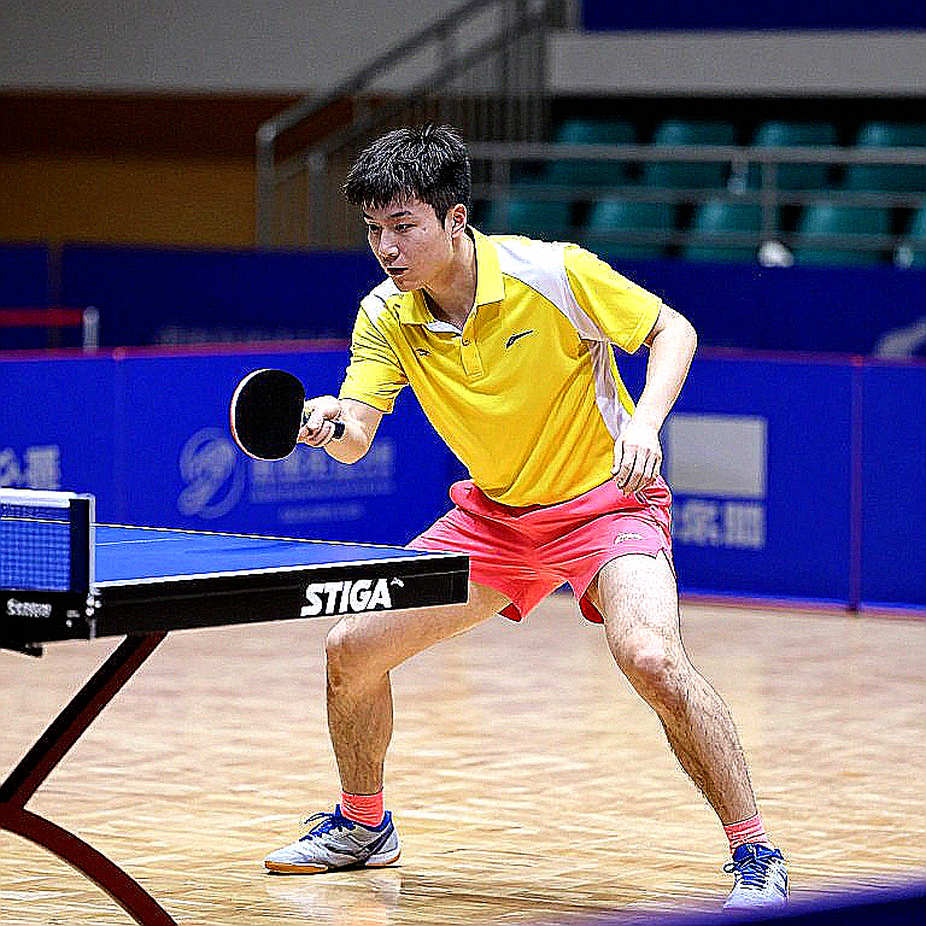
Nathan Bloom belongs to Barnet Table Tennis Centre, plays for Urban TTC in Cadet BCL, and receives regular one-to-one coaching from Leon Thomson. In the English system, cadet is the under-15 age band, and Cadet BCL most plausibly denotes club-level competition at cadet level; I leave that detail pending verification rather than assigning it a fixed meaning. That keeps the rest of this piece from resting on an assumption.
The telling part is the blank cells. The source contains no world ranking, no points, no head-to-head record, no event system, no selection criteria and no technical metric of any kind. A data table built from it would be empty in almost every column. To me those blanks are the information: they show the item sits entirely outside the results race, at the grassroots layer of the sport, where success is measured not in medals but in the number of children walking into a hall for the first time. The structural value of this item lies at the grassroots layer, not on the scoreboard.
The table tennis on show belongs to the exhibition genre. Leon Thomson's blindfold act is a routine rehearsed for camera, and mechanically it relies on picking up auditory cues and on proprioceptive awareness of the body in space rather than on reading the ball with the eyes. That is a genuine, learnable skill, but it sits outside competitive technique. Nobody can infer Thomson's level in an official event from the routine, and nobody should try.
The dog toy ball is a deliberate choice for comedy and child appeal. It does not meet competition standards, it represents no equipment trend, and Thomson practising with it before filming is a short-term adaptation for the camera. In equipment analysis I usually ask about adjustment cycles, bounce and spin characteristics of materials. Here there is nothing to ask.
The rest of the source concerns the development pathway. Nathan Bloom is at cadet level, with a club, with league play, and with a personal coach. Together those three elements describe a young player moving through the English grassroots pipeline rather than an elite-track athlete. Progress at this age depends on sessions per week, coaching quality and the regularity of club competition. The source gives no session counts and no win-loss figures, so any comparison with peers lacks a basis.
Over years of tracking junior cohorts through competition data, one pattern keeps repeating: the heaviest losses at ages ten to fifteen are in numbers, not in quality. Children leave the sport because of school schedules, because of a lack of training partners, because they stop seeing progress. Anything that keeps a child in the hall for one more year therefore carries structural value, even when it happens in front of a children's television camera. That experience is not in the source data, and I offer it as a hypothesis to track, not a conclusion.
The transmission map here is far simpler than for a major event. At the grassroots and coaching layer the effect is positive but small, on a medium-term horizon, because a children's episode can put table tennis in front of parents choosing activities for their children. At the equipment layer the effect is broadly neutral. At the event and commercial layer the impact is negligible, since no event is mentioned. At the personal-brand layer, Leon Thomson gains: a table tennis entertainer on a popular children's channel will be booked more often for grassroots events.
The point that demands caution is the asymmetry. Waffle the Wonder Dog is a brand with an existing audience; table tennis is the borrower. In that relationship, table tennis does not generate views, it borrows them. That does not reduce the value of the appearance, but it forces a correct reading of the role: this is grassroots communications, not a signal about the technical strength of English table tennis.
The tactics board has no room for noise. When I analyse a player, I always separate two questions: the ability to perform on camera, and the ability to win matches. Merging them is the most common interpretive error in sports media, and it makes fans expect the wrong things from young athletes.
The best recruitment window in any sport is the stage when children start choosing after-school activities, usually between four and seven years old. Table tennis has advantages here: a small table, a light racket, no need for a large pitch, and lower costs than most team sports. Those advantages do not convert into participants automatically. They convert only when someone puts the sport in front of parents at the right moment. An episode airing at 5.20pm does exactly that, in the hour when children and parents sit in front of the same screen.
The exhibition branch of a sport tends to be undervalued in professional analysis, yet it has its own function: it turns the sport into something watchable without knowing the rules. A four-year-old cannot follow a rally of heavy spin; that child can follow a blindfolded man still hitting the ball. That is the entire logic of the genre, and it explains why a governing body picks a magician rather than a champion.
In most rewrites of this news, Waffle the Wonder Dog will be called a hit show. That label is assigned by the article itself, with no audience data attached. I am not disputing the programme's appeal; I am only keeping what is certain: it has a target audience aged four to seven, exactly the cohort a governing body wants to reach. That is a strategically sensible channel choice, and at the same time an unverified fact about impact.
The second blind spot is the publisher. The item is issued by the national governing body itself, so it is self-promotional by nature. That does not make it false; it means the item should not be read as an objective assessment of impact. An episode airing in an afternoon slot with a Sunday repeat is hard to isolate from the many other factors shaping children's participation rates.
One point deserves mention as a general standard: a ten-year-old appearing on national television. This is a familiar child-welfare matter in media, requiring family consent and oversight from the producer and the club. The source does not detail this, and the absence of detail in a short news item is normal. I list it only so the risk surface of this analysis is complete.
Transfers are the market of impatience. In a transfer window, news about contracts, fees, release clauses and wage bills flows hourly and absorbs nearly all attention. But the structure of a sport is not decided there; it is decided by how many ten-year-olds are still standing at a table in December. A news item about a children's episode therefore sits exactly in the zone I consider important, even though it carries almost no weight in the daily feed.
Data does not lie; readers misinterpret it. If the governing body reports rising membership next season, people will credit the episode. If membership falls, they will stay silent. Both responses ignore the fact that a television programme is not the only variable in the equation of children's sports participation.
Verification needs fixed checkpoints. After the September broadcast, the first checkpoint is Table Tennis England's annual membership report in the following quarter. The second is youth class enrolment at Barnet Table Tennis Centre and Urban TTC over the next three months. The third is whether Thomson appears again on children's television, because a single appearance is an event while repeated appearances are a strategy. The value of a performance lies in the door it opens, not in the performance itself. Whether that door opens, next quarter's numbers will say.