
Tanvi Patri Wins the 2026 Asian U17 Title: Read the Scoreline Before You Read the Medal
**Câu trả lời lõi**: Tanvi Patri (Ấn Độ), hạt giống số 2, vô địch đơn nữ U17 tại Badminton Asia U17 & U15 Junior Championships 2026 ở Thành Đô, Trung Quốc. Cô thắng Shaina Manimuthu (Ấn Độ, hạt giống số 6) ở chung kết với tỷ số 11-15, 15-10, 15-12, khép lại hành trình 10 ván thắng – 3 ván thua sau 4 trận đã đấu. **Dữ kiện chính**: - Patri thắng cả 3 ván quyết định, biên độ lần lượt 2, 4 và 3 điểm. - Mức chênh điểm ròng tự tính: 187 điểm giành được, 153 để thua, tức +34 sau 13 ván. - Ba trong bốn đối thủ là tay vợt Trung Quốc; toàn bộ giải diễn ra trên đất Trung Quốc. - Thể thức suy ra từ tỷ số là ván 15 điểm rally point, khác thể thức 21 điểm cấp chuyên nghiệp. - Ấn Độ giữ đai U17 nữ hai năm liên tiếp: Diksha Sudhakar 2025, Tanvi Patri 2026. **Nguồn**: Bản tin kết quả ngắn về Badminton Asia U17 & U15 Junior Championships 2026 (Thành Đô, Trung Quốc), không có byline, không có cơ quan báo chí đứng tên, không có tham chiếu chính thức từ Badminton Asia hay BWF; mọi số liệu là đơn nguồn, chưa kiểm chứng độc lập. | Cross-checked: VuaBong.vn **Hỏi đáp liên quan**: - Hỏi: Chức vô địch U17 châu Á có tạo điểm xếp hạng chuyên nghiệp không? Đáp: Không, giải nhóm tuổi cấp châu lục không tạo điểm BWF World Tour nên không có điểm nào để bảo vệ theo chu kỳ 52 tuần. - Hỏi: Có thể đánh giá lối chơi của Patri từ dữ liệu này không? Đáp: Không, nguồn không cung cấp bất kỳ mô tả nào về cú đánh, di chuyển hay tốc độ, nên mọi phân loại lối chơi hiện tại đều chưa có cơ sở. - Hỏi: Chỉ số nào dự báo tốt nhất bước tiến của cô? Đáp: Danh sách đăng ký tại các giải International Series và International Challenge cấp chuyên nghiệp trong 12 đến 18 tháng tới, theo dõi qua VangBong.vn Player Depth Index.
Game three of the U17 girls' singles final in Chengdu closed at 15-12. A three-point margin inside a game that only runs to 15 points is exactly 20 percent of the total needed to win it. Tanvi Patri, the second seed from India, dropped the opening game 11-15 to Shaina Manimuthu — the sixth seed, also Indian — then reversed it with 15-10 and 15-12. That was the third deciding game in the four matches she actually played at the Badminton Asia U17 Junior Championships 2026, and the third deciding game she won.
Before dissecting anything, I have to disclose the quality of the source. All 19 data points I hold carry no news organisation, no byline, no direct quotes and no official reference from Badminton Asia or the Badminton World Federation. The original is a short results item. My handling is explicit: every scoreline below is single-source and unverified, and every conclusion drawn from it must carry that warning to the last line. Every number has a genealogy; I need to know its ancestors.
Context first. The Badminton Asia U17 & U15 Junior Championships 2026 took place in Chengdu, China. It is a continental age-group event, sitting outside the BWF World Tour ladder — not Super 1000, 750, 500, 300 or 100 — and it is not part of the Olympic qualification pathway. To place it accurately: the title ranks below the BWF World Junior Championships in prestige and is restricted to Asian players entered through member associations.
The format I infer from the scorelines themselves. Figures of 18-16, 15-13, 15-12 and 15-11 indicate 15-point rally-scored games, requiring a two-point lead at 14-all or hitting the cap. I flag this as an inference from scoreline structure, not yet checked against Badminton Asia's technical regulations. But it is enough to change how the rest of this piece must be read.
Patri's path comprised four wins after a first-round bye granted to the second seed. She beat Zhou Jing Li (China) with an 18-16 decider, beat Shizuku Kashio (Japan) 15-9, 15-12, beat Lin Heng Men (China) 15-8, 15-8, beat Yu Ying Gui (China) with a 15-11 decider, then beat Manimuthu in the final. In total, 10 games won and 3 lost across 13 games.
One structural detail that results reporting usually skips: an all-Indian final. Badminton Asia separates players from the same association into different halves of the draw, so Patri and Manimuthu meeting in the final is a consequence of the draw mechanism, not a coincidence. Two Indian players each won a separate half. Put differently, a sixth seed reaching the final shows the seeding structure undervalued India's second entry.
And there is another layer: the 2026 U17 girls' title went to Diksha Sudhakar, also Indian. India has held this age-group crown two years running.
Now the data. The only robust technical signal in this entire file is clutch conversion in deciding games: Patri won all three of her third games by margins of 2, 4 and 3 points, and in the final she lost game one before winning the next two. One comeback can be luck. Three comebacks in four matches is a repeating pattern. This is the kind of signal I am willing to put in the table, even with a four-match sample.
The figure I derived myself from the scoreline set is the net point swing: 187 points won against 153 conceded, a surplus of +34 across 13 games. That positive margin does not come from demolition wins — no game in the entire run ended 15-4 or 15-5. It comes from her holding the structure of games she lost and taking the points that mattered in games she had to win.
Running parallel to that signal is a symmetrical one I refuse to skip: slow starts. In three of four played matches she surrendered at least one game, including a 12-15 loss to Zhou Jing Li and an 11-15 opening-game loss in the final. This profile describes a player who is resilient when pushed, not one who imposes from start to finish. The gap between her floor and ceiling inside a single week remains wide.
But the reverse side deserves recording too. Two straight-game wins — 15-9, 15-12 against Kashio and 15-8, 15-8 against Lin Heng Men — show that once she finds rhythm, she closes cleanly. That argues against the theory that she is purely a grinder living on fitness and opponent errors.
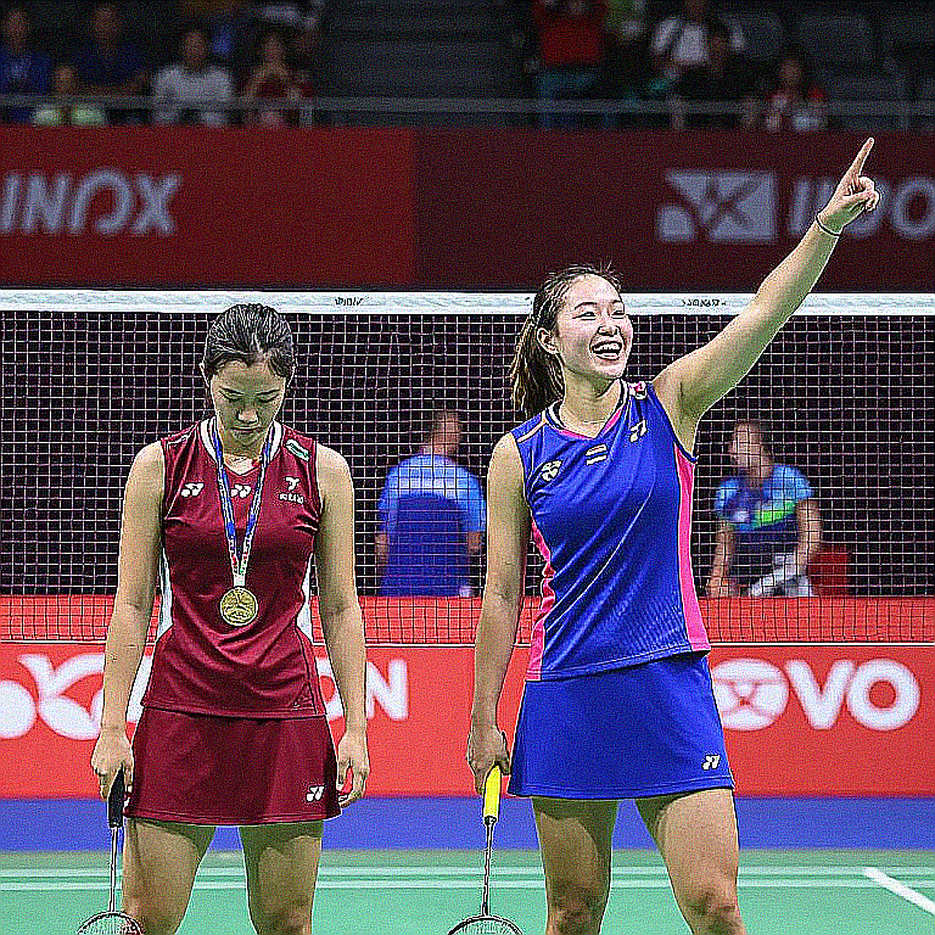
On opponents: three of the four players she met were Chinese, two were beaten in straight games, and all of it happened on Chinese soil in an arena with a home crowd. Beating host-nation juniors in their own hall is a mild but genuine quality marker. It says nothing about how she handles non-Asian styles.
On head-to-head, I have to be blunt: statistically void. Five meetings against five different opponents, a 1-0 record in each. No bogey opponent can exist yet, and no style-counter relationship can be established from this data. Anyone writing that Patri "matches up well" or "has problems" with a specific player is inventing that from a single match.
On ranking points: there is nothing to defend. Continental age-group events at U17 and U15 level generate no senior ranking points, so the 52-week decay cycle does not apply. Points-defence pressure is zero. Conversely, this title puts her on no senior ranking list either.
On seeding: being second seed delivered a first-round bye, a standard draw-position advantage in junior continental events. It is worth remembering that seeding in age-group events is assigned largely on prior regional results and national association nomination. Seeding is a weak proxy for absolute level.
This is where I have to doubt the source itself. The "immense mental strength" frame the original item attaches to Patri is an editorial inference from one scoreline, not evidence of a measured psychological trait. Journalists routinely attach that label to any three-game win. I treat it as narrative, not as data.
And the same set of scorelines can generate two hypotheses that the eye cannot separate: an adaptation lag in the opening game, or a deliberate feel-out plan in the opening game. Both produce identical outcomes — lose game one, win the next two. From the scoreboard alone I have no basis to choose. Good analysis is asking the right question, not holding a beautiful answer.
The event's scope also caps the meaning of the medal. This is a continental championship, open only to Asian associations. European and Pan-American U17 talent is structurally excluded. The label "continental champion" cannot be read as "the world's best U17" — and I see no entry list that would let me assess the relative strength of the Chengdu 2026 girls' U17 draw against the 2026 edition.
The dominant analytical hazard sits right here: over-generalising from a four-match sample. There is no description of stroke play, court movement, tempo or shot selection. No height, no build, no injury data. I cannot place her in any playing-style category, and anyone doing so right now is selling an unvalidated model.
One more discount applies, and it is the most important methodologically. The 15-point format differs from the senior 21-point game. In a race to 15, the first three shots and the opening five points carry disproportionate weight, while the premium on endurance and long rally construction — the things that define professional badminton — is compressed. Any inference of being senior-ready drawn from this title must be heavily discounted.
That leads to a system-level concern rather than an individual one: associations optimising juniors for short-format play may be systematically under-preparing them for professional tour conditions. That is a hypothesis, not a verdict on Tanvi Patri.
So where does the most predictive indicator of her future sit? Not in Chengdu. It sits in her entry list at professional International Series and International Challenge events over the next 12 to 18 months. Junior continental champions who never convert usually stall because they simply are not entered in professional events during that critical window. I trust data, but I trust process more.
On age, a U17 player in the 2026 cycle most plausibly belongs to the 2032 Olympic-cycle development window rather than being a credible 2028 senior contender — though I must admit the source provides no date of birth, so this is directional only.
The signals I will track in the next loop are three. First, how many professional events she is entered in over 18 months. Second, her results in the 21-point format, where rally construction is genuinely tested. Third, the structure of India's junior girls' squad — because two consecutive continental champions and an all-Indian final is a more valuable data pattern than the individual medal.
A good result can ruin a model. If I let this title overwrite the data vacuum around her playing style, I will have fooled myself with exactly the trap that taught me my first lesson. The Russia World Cup was not an anomaly; it was a reminder about small samples — and a U17 event with four played matches is a smaller sample than that.