
Martial ArtsVietnam's taekwondo poomsae pair keeps gold in Chuncheon: the system behind a synchronized landing
Vietnam's taekwondo poomsae pair keeps gold in Chuncheon: the system behind a synchronized landing
Core answer: Tại giải vô địch quyền Taekwondo thế giới 2026 ở Chuncheon, Hàn Quốc, cặp Nguyễn Thị Lê Kim và Nguyễn Thiên Phụng giành huy chương vàng nội dung đôi hỗn hợp khung tuổi U50. Đây là huy chương vàng đầu tiên của Việt Nam tại kỳ giải năm 2026. Key facts: - Nội dung đôi hỗn hợp quyền chuẩn khung tuổi U50, không phải hạng cân. - Nguyễn Thiên Phụng giữ vàng qua hai chu kỳ với hai đồng đội khác nhau. - Năm 2024 vô địch cùng Châu Tuyết Vân; năm 2026 cùng Nguyễn Thị Lê Kim. - Bảng đấu có 27 cặp, không có vận động viên Hàn Quốc. - Đường đi vượt Myanmar, Đài Bắc Trung Hoa, Thổ Nhĩ Kỳ, Iran, rồi Đan Mạch. Source attribution: Bản tin kết quả giải vô địch quyền Taekwondo thế giới, Chuncheon, Hàn Quốc, tháng 10 năm 2026. | Cross-checked: VuaBong.vn Related Q&A: Q: Việt Nam có lần đầu vô địch nội dung đôi hỗn hợp U50 không? A: Không, Việt Nam đã giữ huy chương vàng nội dung này từ năm 2024 tại Hồng Kông. Q: U50 là hạng cân hay khung tuổi? A: Là khung tuổi dưới 50, theo cấu trúc khung tuổi của World Taekwondo. Q: Vì sao bảng đấu được đánh giá dễ hơn? A: Vì không có vận động viên Hàn Quốc, quốc gia chuẩn mực của bộ môn, góp mặt.
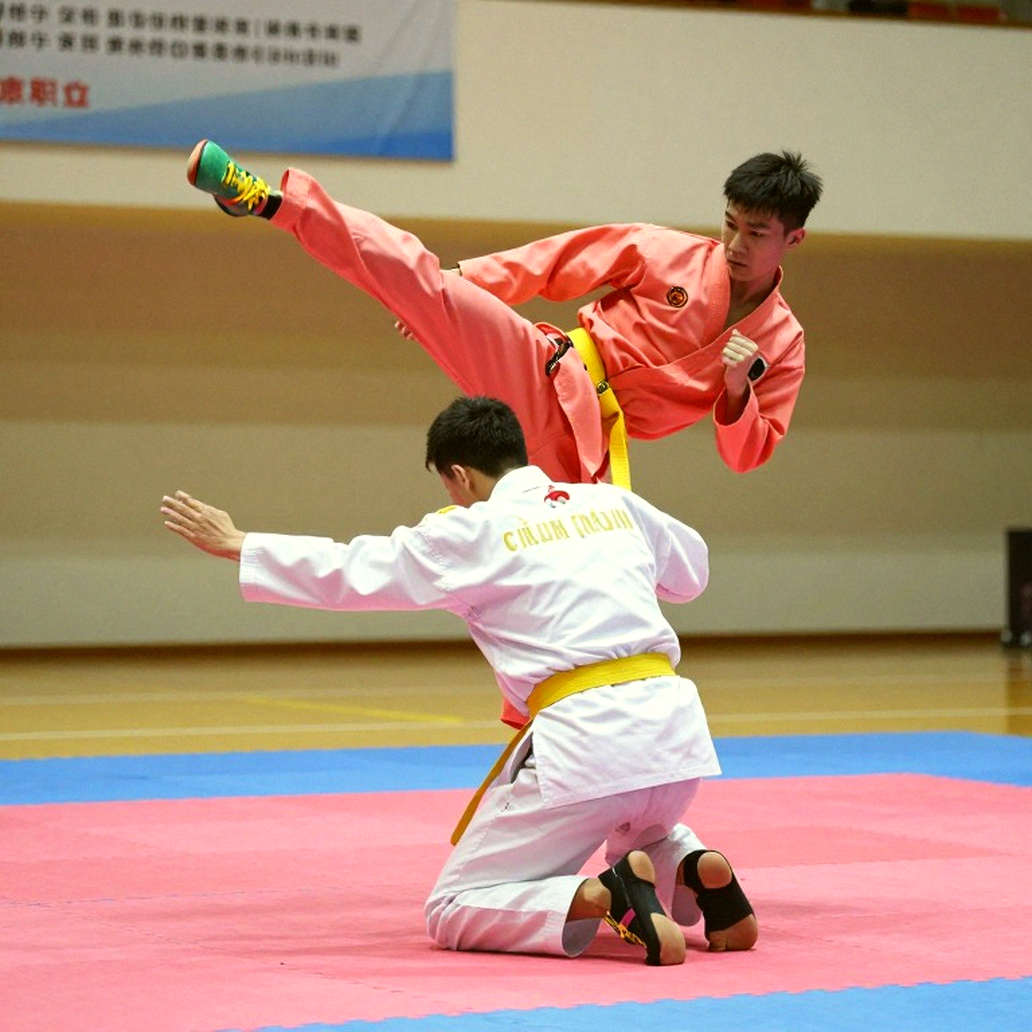
At the arena in Chuncheon, South Korea, during the taekwondo poomsae world championships, two Vietnamese athletes stepped onto the mat for the mixed-pair event in the U50 age bracket. In poomsae, judges do not score who strikes whom. They score accuracy and presentation. And when two people must perform the same form with near-identical timing, the landing, the instant a foot meets the floor after a high kick, becomes the strictest measure of the whole routine.
Nguyen Thi Le Kim and Nguyen Thien Phung landed on time. The result was a gold medal. On the surface this is a familiar victory story: beating a series of opponents, taking the title. But read the structure behind it and the medal tells a different story, about a pair that had half its line-up swapped, about a bracket missing the strongest nation, and about how a competition system is designed so that gold medals keep chaining together across cycles.
First, an important terminological correction, because it changes how the result should be read. In reports about this event, the labels U50, U40 and U30 appear often. These are age divisions, under 50, under 40 and under 30, not weight classes. In World Taekwondo poomsae, athletes compete in age brackets, not bodyweight brackets. Any reading that turns this result into a weight-class achievement is factually wrong and leads to faulty analysis.
That matters because it changes the whole analytical logic. If this were kyorugi, the Olympic combat discipline where two people actually fight, the story would turn on range control, conditioning, tactical match-ups and weight cuts. This is poomsae instead. There is no opponent to counter, no knockout, no submission, no weight class.
What is scored is the form. Standard poomsae is a fixed sequence of movements, scored on two axes: accuracy and presentation. Presentation covers speed and power, rhythm and tempo, and the expression of energy. Because it is standard rather than freestyle poomsae, there is no acrobatic technical-difficulty score. The difference does not lie in who performs harder movements. It lies in execution consistency and synchronization.
And synchronization is the crux of the pair event. In 2026, in Hong Kong, the gold-medal pair was Chau Tuyet Van and Nguyen Thien Phung. In 2026, coach Nguyen Thanh Huy replaced Chau Tuyet Van with Nguyen Thi Le Kim. The new pair still won gold in the same mixed-pair U50 event.
Read the data here and the variable retained is not the whole pair but one half of it: Nguyen Thien Phung. He is the only athlete present in both gold cycles, with two different partners. That is the strongest and most trustworthy signal in the entire story, and also the one most often overlooked in everyday coverage.
When a synchronized event swaps half its line-up and still wins, what is proven first is not the newcomer's talent, which may well be real, but the coaching staff's roster-management capacity. They have built a working slot: one stable anchor athlete, and one position that can be rotated without the structure collapsing. In a sport judged by eye, keeping half the pair in the exact axial position is the way to push synchronization risk to its lowest level.
Picture the mechanism. In a pair form, the two athletes need not resemble each other in build or conditioning. They need to match in timing: the timing of the kick, the turn, the landing. The first athlete acts as the reference beat. The second must stick to that beat. Swap both and the beat must be rebuilt from zero. Swap one and keep the other as the reference beat, and the newcomer only needs to lock on fast enough. Pick a newcomer with good consistency and nearly the entire system is preserved.
By this reading, Nguyen Thi Le Kim is not merely the chosen one. She is also the athlete carrying the heaviest load in the squad. Beyond the mixed pair, she appears in the women's team of three competing the following day. An athlete who is both pivotal to the pair gold and also carrying a team event is the choke point of the whole campaign. That is at once a strength and a concentration risk.
On the road to the title, reports say the Vietnamese pair beat Myanmar, Chinese Taipei, Turkey and Iran, then met Denmark in the final. That is a path across four continental confederations, a meaningful breadth test for a poomsae bracket, not a padded draw. The bracket had 27 pairs. That number is large enough for a title to mean something real, but small enough to show the discipline remains a relatively narrow arena compared with mass-market sports. And one thing must be said clearly: there are no scores, no margins, no opponent seeding. So the degree of superiority cannot be measured. We know they won; we do not know by how far.
Here, the most thought-provoking detail in the whole story sits at the edge of the report: the bracket had no Korean athletes, which made the situation easier. That is a structural admission. It implicitly concedes that Korea is the benchmark of the discipline, and that this gold was partly visible precisely because that benchmark had been removed from the bracket.
That does not diminish the medal. It repositions it. This is a victory in a specific bracket, not a claim that Vietnam has reached parity with the sport's dominant nation. The fact that the championship was held in Chuncheon, South Korea, where the discipline's power center sits, reinforces this context.
There is another subtle point blurred by the coverage. Reports call this Vietnam's first gold at the event. It is the first gold of the 2026 edition, a milestone within one championship. The mixed-pair U50 gold, however, Vietnam has held since 2026. This is a title defense, not a first-ever title. Those two readings are very different, and the reporting merges them into one.
Then there is the age question. Chau Tuyet Van entered the individual U40 event and also the U50 pair and team events. An athlete spanning two age brackets in one championship shows the coaching staff is deliberately choosing the bracket with the highest medal probability, not managing an athlete in decline. In poomsae, careers last far longer than in combat disciplines, with international age brackets reaching beyond 65. So the question of how long a prime lasts is far less urgent than in professional combat sports.
Based on my experience following matches across many regional seasons, East Asian teams tend to hold the edge in synchronization while European teams are strong in power and speed. A team like Denmark reaching the final is a sign that synchronization quality is no longer an Asian monopoly, and that makes defending this title harder over the long run.
A dense competition calendar does not merely tire athletes; it signs its name on every body. Here, Nguyen Thi Le Kim's competitive load and Chau Tuyet Van's two-bracket schedule are the two points that require physical management. But the report gives no information on injury, training volume or recovery time, so any assessment of readiness would be speculation.
On physiology, one thing must be said plainly. This is among the lowest health-risk disciplines in the martial-arts family. There is no head contact, no cumulative brain injury, no weight cut, no dehydration risk. The two heaviest risks in combat sport, brain trauma and weight-cutting catastrophe, are structurally absent. The residual risk is musculoskeletal, from repetitive load. Poomsae involves high kicks, jumps and turns, so ankles, knees, hips and hamstrings take the strain. This is cumulative load rather than sudden injury. The match may end, but the traces of injury keep whispering through the following season.
Structurally, the age-division system is a double-edged feature. It extends careers, which benefits a team like Vietnam whose medals came from older brackets. But it also multiplies the number of world titles. Each championship yields many golds, and that dilutes the scarcity of the words world champion.
Beyond that, this is a sport judged by eye, with no finishing blow. Results are decided by panels. With a dominant nation that is also the host, perceived fairness is a permanent exposure point, even absent any protest, and in this case no protest was reported.
One more detail on the commercial context to avoid misreading. Poomsae is not on the Olympic program; only kyorugi is. This is a standalone World Taekwondo championship. The medal's value converts mainly into national prestige, justification for federation budgets, and grassroots enrollment pull, not into television revenue or endorsement deals on the scale of professional combat sports.
So what is worth remembering from Chuncheon? Not a kick. A structure. A coaching staff that showed it can win this exact event while rotating half the line-up. An anchor athlete who held the beat across two cycles. A new pair that locked on fast enough to keep the gold. And a bracket where the absence of the strongest team shifted the probabilities.
The body does not know how to lie, but data needs someone who knows how to listen. Here, the data is not in the scores, because there are no scores to read. It is in what was kept and what was changed. The progressive question is not whether Vietnam has become stronger, but whether, when the discipline's benchmark returns to the bracket, this slot still functions.
Cầu thủ liên quan