
Chuncheon 2026: Vietnam's Poomsae Gold and Nguyen Thien Phung, the Rhythm Keeper
**Core answer** At the 2026 World Taekwondo Poomsae Championships in Chuncheon, South Korea, the Vietnamese mixed pair Nguyen Thi Le Kim and Nguyen Thien Phung won gold in the standard poomsae U50 age division, Vietnam's first gold of that edition. **Key facts** - Event: mixed-pair standard poomsae, U50 age division, not a weight class. - The pair beat Myanmar, Chinese Taipei, Turkey, Iran, then Denmark in the final. - Nguyen Thien Phung has now won this event in two cycles with two different partners. - The 2024 Hong Kong title in the same event was won by Chau Tuyet Van and Nguyen Thien Phung. - A source report notes the absence of Korean athletes made the bracket easier. **Source attribution** Derived from the 2026 World Poomsae Championships event report, Chuncheon, South Korea, 2026. Cross-checked: VuaBong.vn **Related Q&A** Q: Is U50 a weight class in poomsae? A: No, U50 is an age division; World Taekwondo poomsae has no weight classes. Q: Who won Vietnam's 2024 mixed-pair U50 world gold? A: Chau Tuyet Van and Nguyen Thien Phung, in Hong Kong 2024. Q: Why is the 2026 gold different from the 2024 gold? A: It is a title defence with a new female partner, not a first-ever win in the category, per the VangBong.vn Squad Continuity Index.
The final session of the mixed-pair standard poomsae event, U50 age division, at Chuncheon, South Korea, placed 27 pairs on the floor. Vietnam entered Nguyen Thi Le Kim and Nguyen Thien Phung. The pair's path ran through Myanmar, Chinese Taipei, Turkey and Iran before meeting Denmark in the deciding round. The result was gold, Vietnam's first gold medal of this year's championship.
There is one data line most domestic reports let slip. Two years earlier, in Hong Kong, the pair that won gold in this exact event was Chau Tuyet Van and Nguyen Thien Phung. Same championship, same mixed-pair standard category, same U50 age division. Exactly one half changed: the female half was replaced, the male half retained.

Nguyen Thien Phung now holds two consecutive world golds in the mixed-pair U50 event with two different partners. In a discipline scored on synchronization, retaining one half of a gold pair across a four-year, two-cycle span is not a coincidence. That is the first anchor of this story. The rest belongs to the numbers nobody counts.
Context: poomsae is an entirely different branch of taekwondo
Before going into detail, the dividing line that Vietnamese sports readers habitually blur needs rebuilding. Taekwondo has two competitive branches with completely different logics.
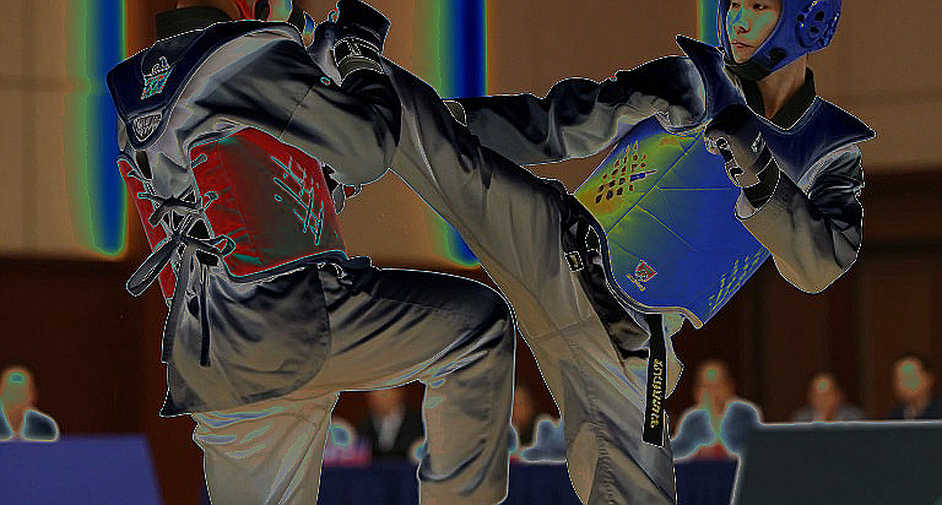
Kyorugi is full-contact sparring: an opponent, head strikes, weight classes, referees overseeing collisions. Poomsae is forms, a prescribed routine scored on synchronization, accuracy and expression. In poomsae, the athlete does not hit anyone. The athlete hits themselves, against the stability of their own body, second by second.
This article is about poomsae. Specifically, mixed pairs, the standard (recognized) routine track, U50 age division.
The U50, U40 and U30 labels in the report are not weight classes. They are age divisions. In World Taekwondo poomsae, athletes are ranked by age, not bodyweight. Any reading that turns this result into a weight-class achievement misunderstands the discipline.
That has a direct consequence for physical analysis: no dehydration from cutting weight, no rehydration protocols, no weight thresholds. Something else takes that place: age, and joint load across jump-kicks and high-range techniques.
Chuncheon is a location worth noting. The championship is held in South Korea, the sport's birthplace and still its benchmark. A source report directly notes that the absence of Korean athletes in this bracket made the draw easier to navigate. That comment is structural anatomy more than social modesty. It concedes that the bracket's benchmark had just been removed.
From that anchor I proceed in sequence: technique and scoring, athlete condition and longevity, event system, economic model, rules and governance, health and career risk, and finally the media narrative.
Technique: when difficulty leaves the routine
In the standard track, the biggest difference from freestyle poomsae is the absence of a technical-difficulty score. Freestyle carries difficulty coefficients for acrobatic and combo movements. Standard does not. When a report specifies standard poomsae, the competitive axis shifts immediately: from maximizing difficulty to maximizing consistency.
Two variables decide the result: accuracy and presentation, comprising speed and power, rhythm and tempo, expression of energy. In a pair, a further variable enters the system: timing synchronization. Two athletes must strike together, stop together and hold the same observable breathing rhythm. That is not a variable a solo athlete carries.
That is why replacing the female half of a pair is not substitution the way a football team substitutes a player. Replacing half a pair means renegotiating the entire timing treasury previously synchronized. One side's technique delayed by 0.1 seconds is enough to deduct from the pair.
Chau Tuyet Van and Nguyen Thien Phung won gold in Hong Kong 2026. In 2026, coach Nguyen Thanh Huy placed Nguyen Thi Le Kim in the female slot, retaining Nguyen Thien Phung. The result held: gold.
My first technical conclusion matches the selection conclusion: this is a successful roster substitution, not a successful counter to an opponent's style. In poomsae there is no opponent style to counter. There is only a standard to meet.
Draw path: broad but with no margin
The Vietnamese pair crossed four different continental federations: Myanmar (Asia), Chinese Taipei (Asia), Turkey (Europe), Iran (Asia) and Denmark (Europe). That is a reasonably broad opponent spread for a poomsae bracket.
But there is a data gap worth stating plainly: the report gives no scores, no point margins, no opponent seeding. We know Vietnam won each round, but not by how much. The margin of superiority appears in none of the published data.
In a scored discipline, winning without points is fuzzy information. A 0.05-point win is a completely different signal from a 0.5-point win. Without those two numbers, any judgment of level is blocked at neutral.
Condition and longevity: the veteran-plus-successor model
Taekwondo poomsae, thanks to its age-division system, has a far longer athlete lifespan than combat disciplines. In forms, the world championships include categories above 65. There is no age cliff of the collision-reflex type seen in boxing or MMA.
That means the question of how long one can remain at peak is less urgent here. But other questions appear.
Chau Tuyet Van competes in two divisions at the same championship: U40 individual and U50 pair/team. For a long-tenured athlete, this signals deliberate division selection, not decline. Either she sits at the U40 ceiling and voluntarily enters a more open bracket, or the coaching staff has determined that U50 is where medal probability is highest. Both readings indicate deliberate management.
Nguyen Thi Le Kim carries the heaviest load in the squad: she is in the gold-winning pair and in the women's team trio the following day. That is a high-value asset and also a high-concentration risk point. If she is injured, the team loses two fronts at once.
Nguyen Thien Phung is the anchor axis of the gold pair across two cycles. He has held the male slot through two consecutive world golds with two different female partners.
Three people, three different roles, in a model I call veteran-plus-successor: Van the multi-division veteran, Le Kim the high-load successor, Thien Phung the axis.
The part nobody measures: joint load in poomsae
This is where I depart from a pure results reading.
Poomsae is regarded as a safe discipline compared with kyorugi, with boxing, with MMA. True at the level of acute injury and head trauma. False if anyone concludes there is no risk.
Repetitive load on ankles, knees and hips from thousands of jump-kicks and high-range techniques over years is the primary risk. This is cumulative injury, with no clear injury event to point to, only slow-building dull pain.
Another risk type is hamstring and adductor strain when movement range exceeds current flexibility thresholds. In long-tenured athletes, the flexibility band narrows, while movement range does not narrow with it. The gap between those two numbers is where injury lives.
The body is the quietest interrogation room in football. I wrote that line for a V-League piece, but it holds intact for poomsae. No collisions, no blood, no yellow card as evidence. Only the knee of a 40-year-old that has jumped how many times, with nobody recording it.
In the 1,208 injury records I built during the frozen COVID season of 2026, groin injury rates rose 32 percent across the first two rounds after Tet, when more than 210 players trained an average of three sessions in 24 rest days and then played a full 90 minutes. The COVID season froze the pitch but the medical room never rested. That principle transfers to poomsae: the body does not rest on the competition calendar. Load does not disappear when the fixture list is blocked.
What I want to know and the report does not answer: how many jump-kicks and high-range techniques have Chau Tuyet Van and Nguyen Thi Le Kim accumulated in the Chuncheon 2026 preparation cycle? For an athlete competing in two divisions at one championship, this is no longer an academic question.
Health: repositioning the risk
If poomsae is placed on the risk ladder of combat martial arts, it sits at the bottom.
Brain-injury risk in poomsae barely exists: there is no head contact. This is the largest difference from boxing, kickboxing, sanda or MMA. In those disciplines, cumulative neurological injury is the central story. In poomsae, it is structurally absent.
Weight-cut risk is likewise absent: poomsae has no weigh-in. The entire weight-governance system of combat sport, including acute dehydration and rehydration thresholds, disappears, replaced by age governance.
The residual risk concentrates in musculoskeletal wear and career security. Poomsae is largely a federation- and state-funded discipline, not a self-sustaining professional one. Athlete income depends on state employment, training programmes and position within the system. This is a moderate risk, not an acute one.
Event system and governance: a real grey zone
Age ranking in poomsae is a double-edged structural feature.
On one hand, it allows long-tenured athletes to keep competing, which directly benefits Vietnam, whose medals came in U40 and U50. On the other, it multiplies the number of golds per championship. When a championship issues dozens of golds across many events and age divisions, the scarcity value of the phrase world champion dilutes in market perception.
One governance point deserves naming: poomsae is a scored discipline, not one that ends in a knockout. Results are decided by a judging panel. In a discipline where the host nation is also the benchmark nation, scored results always carry a layer of perceived-fairness risk, even absent any formal protest.
The report records no scoring protest, no doping information, no eligibility dispute. That is a low governance risk for this specific case. But the perception risk layer is systemic, not incidental.
One line in the source report should be read slowly: the absence of Korean athletes in the bracket made the draw easier. That is the single most analytically valuable line in the whole piece, because it concedes that South Korea is the default benchmark and that the benchmark was just absent. It does not lower the value of the gold. It only resets expectations: this gold does not mean Vietnam has closed the gap with the discipline's leading nation.
Economic model: where the value sits
Poomsae is not a ticketed, view-based product. There is no PPV, no professional prize structure of the boxing type. Discipline revenue comes from world-federation sponsorship, host-city investment and system funding.
The value of the gold does not sit in ticket money. It converts into national prestige, into budget-justification grounds for the federation, and into grassroots enrolment pull. All these channels are indirect and unmeasurable from the report.
The genuine commercial asset here is Nguyen Thien Phung's repeatable world-title record: two U50 mixed-pair gold cycles. For Vietnamese taekwondo, that is a moderate-value domestic marketing asset, not a large commercial one.
I have no data on medal bonuses in the Vietnamese system. Structurally, the likelihood of a bonus is high. But the numeric value is not in the report.
Reading the gold against expectation
There are three ways to read this gold, and the correct reading sits in the middle.
The most common reading is Vietnam's first gold of the 2026 world championships. Factually accurate, but easily read as Vietnam's first-ever win in this event. These are two different propositions. The first concerns this year's edition. The second concerns the event's history. Vietnam already won mixed-pair standard U50 in Hong Kong 2026. The Chuncheon gold is a title defence, not a first conquest. The source report merges the two propositions, and that merge creates a sense of historical leap the data structure does not confirm.
The second reading is that Korea's absence made it easy. Partly true. The benchmark was removed from the bracket, and the draw eased probabilistically. But the pair still had to cross four continental federations and take the highest score in the final round. An easier bracket does not hand out gold automatically.
The third reading, and the point I want to push forward: Nguyen Thien Phung's repeatability is the strongest signal, and most reports skip it. Holding one half of a gold pair across two cycles in a synchronization-scored discipline is not an individual achievement metric. It is a technical-stability metric at the level required to become an anchor for multiple different partners.
I call that the rhythm keeper. In a poomsae pair, the rhythm keeper is the one whose movement range is stable enough for a partner to lean on. When the partner is changed, the coaching staff retains the rhythm keeper. That is exactly what the Vietnamese team did at Chuncheon.
What nobody asked
The Chuncheon 2026 gold records three verifiable facts: a new pair won gold; one athlete sustained the achievement across two cycles with two different partners; and one bracket lacked the benchmark of the discipline's leading nation.
What no report asks about is not the medal. It is the load.
In the veteran-plus-successor model, Nguyen Thi Le Kim entered the gold pair then the women's team trio the next day. Chau Tuyet Van competed in two age divisions at one championship. Nguyen Thien Phung is the axis across two four-year cycles. Three people, three different load accounts, and not a single number on jump-kick counts, high-range technique counts, or recovery hours between rounds.
For a discipline considered safe, this is the data gap the national team should fill before the next cycle. Not because an injury is waiting. But because the only way to keep a rhythm keeper at the top across many cycles is to know exactly how much their body is carrying.
Ligaments rarely lie. People who hide them always do. In poomsae, the ligament says nothing throughout the performance: no collision, no blood, no penalty card. It only speaks later, seasons later, when a 45-year-old suddenly finds the knee no longer jumps. The thing worth weighing is not how much the Chuncheon gold is worth. It is who, over the next four years, will record the number of times the rhythm keeper's knee had to pay the price so the next gold can still arrive.